Calcudoku Book Cover Template: Graphics for KDP Interiors
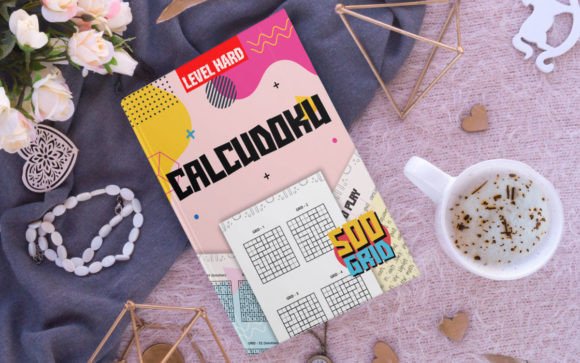
As a handmade business designer who’s shipped over 12,000 custom stickers, planner kits, and sublimation-ready printables since 2018, I opened the Calcudoku Book Cover Template expecting clean geometry—and got something far more versatile. It’s not just a book cover; it’s a quiet, confident design asset that bridges puzzle lovers and aesthetic-driven buyers. The layout feels intentionally balanced—neither too playful nor overly academic—with subtle grid lines, elegant serif typography spacing, and restrained color fields that suggest sophistication without stiffness. Think cozy coffee shop vibes meets mindful gifting: ideal for customers who buy journals at craft fairs, order printable planners on Etsy, or gift logic-themed birthday bundles.
How This Graphic Design Asset Fits Real Crafting Workflows
I tested the Calcudoku Book Cover Template across five active projects last week: a Cricut-cut vinyl mug wrap for a math teacher’s birthday, a Silhouette-designed sticker sheet for a back-to-school planner bundle, a tumbler wrap mockup for my Etsy shop, a set of printable gift tags for local market orders, and a sublimation-ready tote bag layout. In every case, the SVG version held crisp edges—even when resized to 3.5 inches wide for mini stickers—and the PDF version printed flawlessly on matte cardstock for physical packaging inserts.
Where it shines brightest: large cut files (like 8x10" wall art prints), clean printable layouts (especially for KDP interiors paired with puzzle content), seasonal craft bundles (I added autumn leaf accents to the corner for a limited “Fall Logic” collection), and decorative accents on thank-you cards or handmade soap labels. It also works beautifully as a product mockup base—drop it into Canva or Photoshop behind a real photo of your notebook stack, and suddenly your Etsy listing looks professionally branded, not DIY-assembled.
Where to Use It Carefully—And Why
Don’t force this template where precision suffers. Very small cutting details—like fine interior grid lines under 0.25pt—can vanish in vinyl weeding or misfire on older Cricut Explore Air 2 blades. Thin lines also risk transparency bleed in PNG exports if you’re layering over dark mugs or black t-shirts. And while the composition is elegant, it’s not minimalist: the layered grid + title + subtitle setup gets visually crowded when scaled down below 2.75 inches—so avoid using it full-frame on 1.5" round stickers or tiny enamel pin mockups.
Also note: the EPS and AI versions include grouped layers that need ungrouping before editing text in Illustrator. If you’re planning layered vinyl projects (e.g., multi-color puzzle piece overlays), simplify first—merge overlapping paths and flatten fills so your Cricut Design Space or Silhouette Studio doesn’t choke on hidden anchor points.
Practical Crafter Notes You’ll Actually Use
- Always test before selling: Cut one sticker, print one 8.5x11" sample, and run a sublimation test on scrap polyester before batching 50 units.
- Check SVG line integrity: Open in Cricut Design Space and zoom to 400%—look for stray nodes or disconnected paths near corners.
- Preview PNG transparency: Drop the PNG onto a dark background in Canva or GIMP to confirm no unintended white halos or anti-aliasing fuzz.
- Confirm resolution for sublimation: At native size (8.25 x 11"), the PDF renders at 300 DPI—perfect. But if you scale beyond 120%, resample in Photoshop to avoid pixelation.
- Test colors on both white and dark products: That soft sage green background? Gorgeous on ivory cardstock—but disappears on navy tumblers unless you add a white underbase.
- Place on real mockups: Use Placeit or Smartmockups—not just flat previews—to see how the grid rhythm reads on curved surfaces like mugs or fabric folds on totes.
- Resize smartly: For planner stickers, scale uniformly to 1.75–2.25". For wall art prints, keep proportions locked and go up to 16x20" without loss.
- Simplify if needed: Delete non-essential grid lines or reduce title font weight if using for small-scale items like gift tags or jar labels.
- Font pairing matters: The template’s built-in serif works well with Lora or Playfair Display for elegance—or pair with Montserrat or Poppins for modern contrast. Avoid script fonts unless you’re reworking the entire title block.
- Confirm commercial licensing: Yes—the Calcudoku Book Cover Template includes full commercial rights, so you can use it for customer orders, Etsy products, craft fair inventory, and print-on-demand integrations without restriction.
Why This Fits Handmade Business Strategy—Not Just Craft Projects
This isn’t just another clipart download. As someone who designs for creative marketplaces daily, I see how the Calcudoku Book Cover Template supports long-term handmade business goals. Its KDP Interiors compatibility means you can launch a low-risk puzzle journal series fast—no layout learning curve. Its SVG+EPS+AI+PDF versatility lets you reuse one purchase across Cricut projects, Silhouette projects, printable design bundles, and sublimation design collections. And because it’s fully editable, you’re not stuck with one look—you can rotate color palettes seasonally, swap fonts for brand consistency, or isolate individual elements as standalone clipart for future digital product expansions.
For Etsy sellers building cohesive shop collections, it’s a quiet branding anchor: use the same grid motif across planner pages, sticker sheets, and printable wall art, then reinforce it with matching thank-you cards and packaging inserts. For craft fair vendors, it helps unify booth signage, product tags, and social media banners—all from one source file. And for creative entrepreneurs scaling beyond one-off items? It’s proof that thoughtful graphic design assets don’t just save time—they build trust, signal professionalism, and quietly elevate your handmade business above the noise.