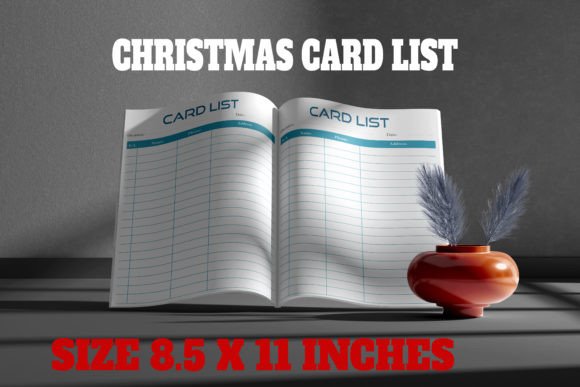
Christmas Card List KDP Interiors
A Designer’s First Look: Clean, Calm, and Craft-Ready
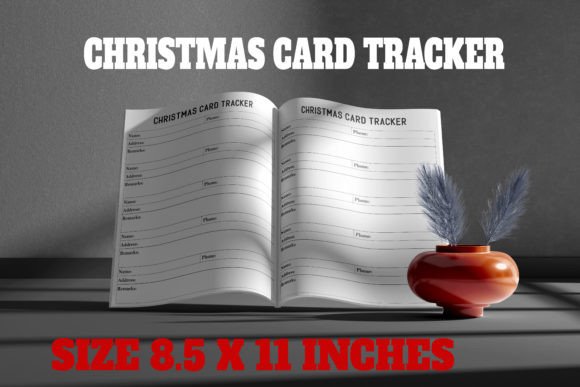
Opening Christmas Card List KDP Interiors feels like flipping through a well-curated holiday stationery collection—soft but intentional. It’s not flashy or cartoonish; it leans into quiet elegance with balanced negative space, gentle typography, and interior-focused layouts that suggest warmth without clutter. As someone who’s stitched hundreds of holiday designs onto baby onesies, linen tea towels, and boutique aprons, I immediately saw its potential—not as a standalone motif, but as a grounded, versatile foundation for personalized embroidery projects.
Where This Design Shines in Real Embroidery Work
I tested Christmas Card List KDP Interiors on a natural linen tote bag meant for a local craft fair pop-up. The design sat beautifully along the lower front panel—neither overwhelming nor shrinking into the background. Its 8.5 x 11 inch size gives plenty of breathing room for thoughtful placement, and the bleed ensures clean edges when printed or cut for applique backings. Because it includes EPS, SVG, DXF, and PNG files, I could easily isolate individual name lines or interior elements to resize for smaller hoops—say, a 4” x 4” cap or a 3” x 3” embroidered patch for a child’s sweater.
It works especially well for holiday embroidery that values legibility over ornamentation: think monogrammed kitchen towels for hostess gifts, pillow covers for nursery decor, or personalized sweatshirt cuffs for small-batch apparel brands. The clean layout translates cleanly into satin stitch borders and subtle fill stitch backgrounds—no dense, muddy areas that trap lint or distort on textured fabrics. As an embroidery file, it respects fabric integrity rather than fighting it.
Real-World Fit: What Projects Does It Elevate?
- Personalized gifts: Names and dates stitch crisply—even on lightweight cotton baby blankets, thanks to consistent line weight and open spacing.
- Small shop products: Looks polished on printable mockups for Etsy listings, especially when paired with neutral thread colors (ivory, charcoal, forest green).
- Commercial embroidery: The editable nature of the files lets me adapt interior pages for client branding—adding a boutique logo beside the list, or swapping fonts for cohesive shop identity.
- Handmade product consistency: Because all 300 pages share visual rhythm, stitching a set of six matching tea towels feels unified—not repetitive.
Where to Proceed With Care
While Christmas Card List KDP Interiors is thoughtfully built, it’s not universally forgiving. On stretchy fabrics like jersey or thin knits, the fine interior lines can blur if stabilizer isn’t layered precisely—especially around delicate corners or tight curves. I recommend testing on scrap first, using medium-weight cutaway stabilizer and reducing stitch density slightly if your machine allows.
Dark fabric requires extra attention: the lighter interior elements (like faint grid lines or pale script) may need reworking in vector software to ensure contrast. And on curved surfaces—caps, mugs with embroidery-ready wraps, or rolled pillow hems—the topmost interior rows can compress visually. A quick scale-down of 5–7% often preserves proportion without sacrificing clarity.
Also worth noting: while the PNGs are sharp at 300 dpi, they’re raster-based. If you plan heavy resizing for large-format applique or oversized wall hangings, lean into the EPS or SVG files instead—they’ll hold crispness across scales.
What This Design Adds to Your Finished Product
Using Christmas Card List KDP Interiors elevates perceived value—not because it’s ornate, but because it signals intention. Customers notice when a holiday gift feels curated, not generic. A custom embroidered apron with names neatly listed inside a soft border reads as heirloom-quality. A baby onesie with a single, centered interior page says “this was made just for you,” not “I ran a template.”
That quiet professionalism builds trust. For Etsy sellers and craft business owners, it helps differentiate from mass-produced digital downloads—especially when paired with thoughtful thread choices and precise hooping. And because it’s part of the Kdp Interiors category, it fits naturally alongside other cohesive design assets, making it easy to bundle with coordinating patterns or seasonal graphics for digital product previews.
Practical Notes Every Embroidery Designer Should Keep Handy
- Always test Christmas Card List KDP Interiors on scrap fabric first—especially if stitching on textured or dark materials.
- Check thread color contrast early: ivory on oatmeal linen reads differently than white on black denim.
- Review stitch density in your embroidery software—some interior lines may benefit from slight simplification for dense fabrics.
- Confirm hoop size compatibility before digitizing; smaller versions may require manual adjustment of spacing between entries.
- Inspect tiny details at 200% zoom—especially letterforms and corner junctions—before sending to machine.
- Try black-and-white mockups to assess balance and hierarchy without color distraction.
- Use proper stabilizer: cutaway for knits, tear-away for stable wovens, and fusible + cutaway for lightweight linens.
- Verify licensing terms before selling finished items—Christmas Card List KDP Interiors is a digital embroidery file, not a commercial license by default.
Final Thought: A Quietly Powerful Tool for Makers
Christmas Card List KDP Interiors won’t shout—but it doesn’t need to. In a market flooded with loud, glitter-heavy holiday graphics, its calm interior focus makes it unusually adaptable. It’s the kind of design asset that supports your voice rather than competing with it. Whether you’re stitching for joy, building a craft business, or delivering polished client work, this is one of those rare machine embroidery designs that feels like a collaborator—not just content to fill space.